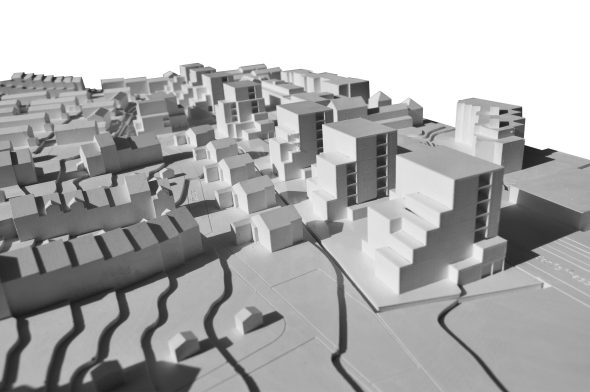
Cooperative Housing and Kindergarten, Zurich
Inclusive and Adaptable Collective Housing
As a catalyst between city and countryside, this project draws its strength from its programming, which is divided into eight distinct plots. This distribution allows the housing units to benefit from multiple orientations while also creating gaps in the built environment at ground level. Pedestrians can move freely between the plots, transitioning from the vibrancy of Dübendorfstrasse to the tranquility of the garden. Workshops, bicycle storage, and other shared spaces transform these passageways into micro public spaces, fostering interaction.
For more rationality, the facades follow a calm and orderly design, giving the buildings a monolithic appearance. This approach ensures long-term durability, particularly through the use of a single-material aesthetic. This uniformity is punctuated by planted railings and red blinds, adding contrast to the overall design.
This approach gives the building true long-term durability, particularly due to the single-material aspect we have developed. The uniformity is broken by the planted railings and red blinds.


Aligned with the underground parking, a 2.50m / 3.00m grid defines the architecture of the facades and the housing units. Inside, each home is designed to ensure maximum living comfort through careful consideration of privacy and spatial flexibility.
The living areas are oriented to take advantage of the best exposures. The typological distribution is carefully studied to create a mix of small and medium-sized units on each floor. Thanks to a staggered arrangement of volumes, every apartment benefits from at least two orientations and has a private outdoor space.
Shared housing typologies are integrated into the street-facing buildings, with one unit placed every three levels per plot.
Circulation areas are wide and naturally lit, designed to serve as communal spaces.


